


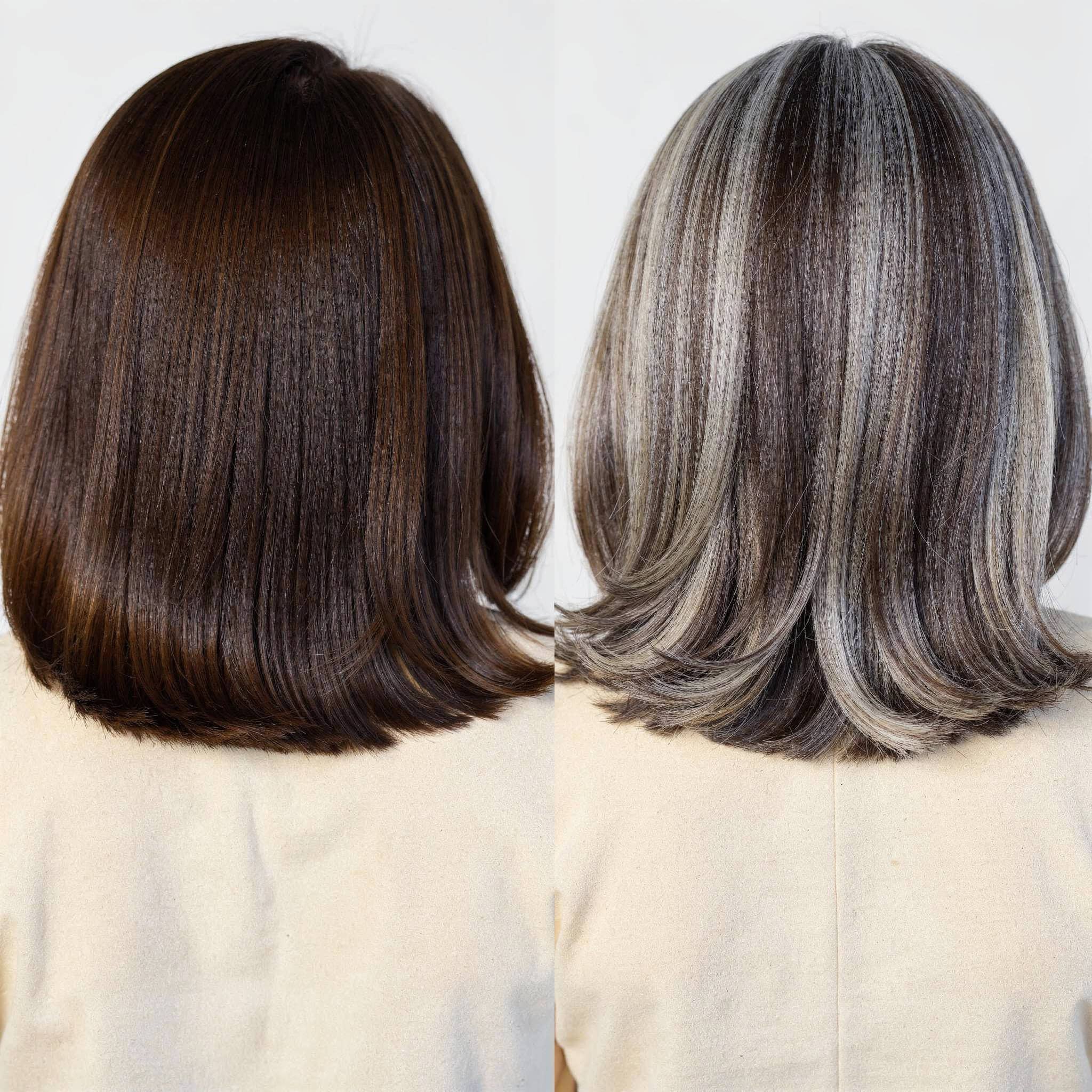
You’ve noticed the gray coming in. Maybe it’s a few strands at the temples. Maybe it’s a full salt-and-pepper pattern that seems to have shown up overnight. Either way, you’re here because you want to do something about it, you’re just not sure what.
The two main options are gray coverage and gray blending. They sound similar, but they look different, cost different amounts, and require very different maintenance schedules. This guide walks you through both so you can show up to your next color appointment knowing exactly what to ask for.
The Short Answer
Gray coverage uses permanent color to hide every gray hair completely. Gray blending uses highlights, lowlights, or demi-permanent color to soften the contrast between your gray and natural hair so the gray is still there, but it looks intentional. Coverage gives you a uniform, “no one will ever know” result. Blending gives you a dimensional, low-maintenance look that grows out gracefully. The right choice depends on how much gray you have, how often you want to visit the salon, and the look you’re going for.
What Is Gray Coverage?
Gray coverage is what most people picture when they think about “coloring gray hair.” Your colorist applies a permanent single-process color from roots to ends that completely covers every gray strand. The result is a solid, uniform color, your chosen shade from root to tip with no gray visible.
How it works: Permanent color opens the hair cuticle, deposits pigment inside the strand, and replaces the missing melanin that causes hair to appear gray. Professional formulas like INOA ammonia-free color can achieve 100% gray coverage without the harsh chemicals found in traditional dyes.
Maintenance: This is the high-maintenance option. Because the line between your colored hair and your natural gray roots is sharp, regrowth is visible within 3-4 weeks. Most full-coverage clients book a root touch-up every 4-6 weeks.
Best for:
- People who want zero visible gray
- Those who prefer a solid, uniform color
- Clients with less than 50% gray who want to match their natural shade
- Anyone who doesn’t mind regular salon visits
What Is Gray Blending?
Gray blending takes the opposite approach. Instead of hiding your gray, your colorist works with it using a combination of techniques to make the gray look like a natural part of your overall color.
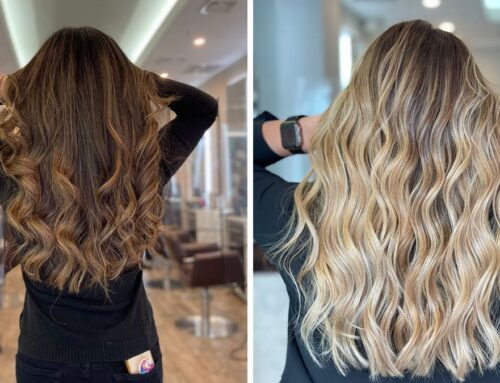
How it works: Your colorist strategically places highlights and lowlights throughout your hair. The lighter pieces blend with your gray strands. The darker pieces add depth and dimension, so the gray doesn’t look flat or dull. The result is a multi-tonal, lived-in look that softens the contrast between your pigmented hair and your silver.
Common techniques used in gray blending include:
- Highlights and lowlights — foil-placed pieces that create dimension and break up the gray pattern
- Balayage — hand-painted highlights that create a soft, natural gradation
- Face-framing highlights — lighter pieces around the face that brighten your complexion and blend hairline grays
- Demi-permanent color — a gentler formula that softens gray without fully covering it, depositing a translucent wash of color
- Glaze treatments — add shine and tone to gray hair, reducing brassiness or yellowing
Maintenance: This is the low-maintenance option. Because the color is blended rather than solid, there’s no harsh “skunk line” as your roots grow in. Most blending clients come in every 8-12 weeks, some even stretch to 4-5 months between appointments.
Best for:
- People who want a natural, dimensional look
- Those who prefer fewer salon visits
- Clients who are starting to embrace their gray but aren’t ready to go fully silver
- Anyone who wants a softer grow-out with no visible root line
Gray Coverage vs Gray Blending: Side-by-Side Comparison
Here’s how the two approaches stack up:
Look: Coverage gives you one solid shade, clean and uniform. Blending gives you multiple tones dimensional and natural-looking.
Grow-out: Coverage creates a visible root line within 3-4 weeks. Blending grows out softly with no harsh line.
Maintenance frequency: Coverage needs touch-ups every 4-6 weeks. Blending needs touch-ups every 8-12 weeks.
Annual salon visits: Coverage runs 8-12 visits per year. Blending runs 4-6 visits per year.
Works best with: Coverage works well at any gray percentage. Blending works especially well for clients with 20-60% gray.
Hair health: Coverage applies permanent color to the full head every time. Blending targets specific sections, which means less overall chemical processing.
How Your Gray Percentage Affects the Decision
The amount of gray you have plays a big role in which approach works best.
Under 20% gray. You have options. A few well-placed partial highlights can blend those early grays beautifully. Or a quick root touch-up can cover them completely. At this stage, both approaches are low-effort.
20-50% gray. This is where the decision matters most. Full coverage still works well, but you’ll notice regrowth faster because the contrast between colored and natural hair is sharper. Blending starts to shine here, the mix of gray and pigmented hair creates a natural canvas that highlights and lowlights complement beautifully.
Over 50% gray. Both options still work, but the strategy shifts. Full coverage on heavily gray hair requires a skilled colorist because gray strands are coarser and more resistant to color; they don’t absorb pigment the same way pigmented hair does. For blending, your colorist may reverse the approach: instead of lightening dark strands to match the gray, they’ll add lowlights to create depth and warmth within the silver.
Over 75% gray. Many clients at this stage start considering a full transition to natural silver. Blending becomes a graceful bridge; your colorist can gradually reduce the amount of color at each appointment until you’re fully gray. This avoids the awkward “growing it out” phase that stops so many people from going natural.
You Don’t Have to Choose One Forever
Here’s something most articles don’t mention: your approach can change as your gray progresses.
Many of our clients at Numi start with full coverage when they first notice gray in their 30s or 40s. As the gray increases and maintenance becomes more demanding, they transition to blending. Some eventually let the gray grow in completely, with blending as the bridge.
Others go the opposite direction; they start with blending, decide they want more coverage, and switch to a full single process.
There’s no permanent commitment. Your colorist can adjust the approach at any appointment based on where you are, what you want, and how your hair is responding.
What to Tell Your Colorist at Your Next Appointment
If you’re not sure which approach is right for you, start by answering these questions before your appointment:
How do you feel about seeing some gray? If the answer is “absolutely not,” coverage is your path. If you’re open to seeing some gray as long as it looks good, blending will work well.
How often do you want to come to the salon? If every 4-5 weeks feels fine, coverage works. If you’d rather stretch to 8-12 weeks, blending is the better fit.
What look do you prefer? Solid and uniform, or dimensional and natural? Look at photos of both and see which one you’re drawn to.
What’s your budget? Blending appointments may cost more per visit (because highlights take longer), but you’ll have fewer of them per year. Coverage appointments are shorter but more frequent. The annual cost often works out similarly.
Bring these answers to your consultation, and your colorist will build a plan around them.
We Get This Question Every Day
If you’re on the fence between covering and blending, you’re not alone. This is literally the most common conversation our colorists have with clients over 40.
There’s no wrong answer. Both options look beautiful when done by someone who understands your hair. The “right” choice is the one that fits your lifestyle, your maintenance tolerance, and how you want to feel when you look in the mirror.
And if you change your mind six months from now? That’s fine too. We’ll adjust.
Book Your Gray Coverage or Blending Appointment at Numi Hair
Whether you want every gray strand covered or a soft, dimensional blend that works with your natural silver, our color team will build the right plan for your hair. We use INOA ammonia-free color for coverage services and a full range of highlighting and balayage techniques for blending, all customized to your gray percentage, hair type, and goals.
Why clients trust Numi Hair:
- Named Best Hair Salon in Westchester and a Top 100 Salon in the US
- 993+ Google reviews at 4.9 stars
- Our colorists work with every stage of gray, from first silvers to full silver transitions
Book your appointment online or call us at (914) 574-6402. We’re located in Scarsdale, just off the Bronx River Parkway — easily accessible from White Plains, Eastchester, Bronxville, Yonkers, and all of Westchester County.
Frequently Asked Questions
Can you blend gray hair with highlights?
Yes. Highlights are one of the most effective ways to blend gray hair. Your colorist places lighter pieces throughout your hair so the gray strands blend in naturally instead of standing out. This works especially well for clients with 20-60% gray.
How often do you need to touch up gray blending?
Most gray blending clients come in every 8-12 weeks. Because there’s no hard root line, the grow-out is gradual and natural-looking. Compare that to full coverage, which typically needs a touch-up every 4-6 weeks.
Is gray blending more expensive than full coverage?
A blending appointment usually costs more per visit because highlights take more time. But because you go less often, 4-6 visits per year instead of 8-12, the total annual cost is often similar. Your colorist can estimate both options during a consultation.
Can you switch from gray coverage to gray blending?
Yes. This is one of the most common transitions we do. Your colorist will gradually introduce highlights over 2-3 appointments while reducing the amount of full-coverage color. The transition usually takes 3-6 months and avoids any awkward grow-out phase.
Does gray blending work on dark hair?
Yes, but it requires a skilled colorist. Dark hair creates more contrast with gray, so the highlight placement needs to be strategic. Techniques like balayage and lowlights work well to soften that contrast and create a natural, dimensional result on brunettes and dark brown hair.
Numi Hair Salon is located at 69 Harney Road, Scarsdale, NY 10583 — just off the Bronx River Parkway. We serve clients from White Plains, New Rochelle, Eastchester, Bronxville, Hartsdale, and throughout Westchester County.